Showing posts with label Common Core Resources. Show all posts

Thursday, February 19, 2015

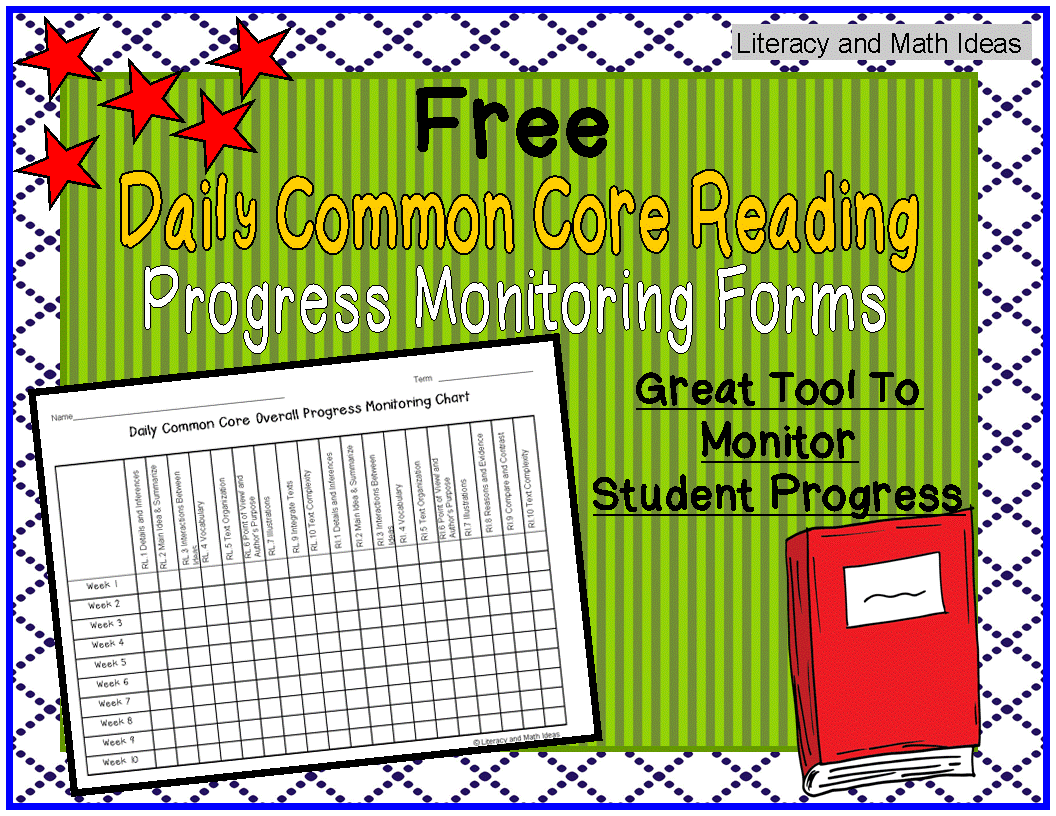
Free Common Core Reading Progress Monitoring Chart


Hello everyone!  I am back with a Common Core progress monitoring freebie.  This is designed to accompany my daily Common Core reading practice, but can be used to progress monitor any Common Core document.  It can be kept inside of student folders or portfolios and is a great way to communicate with both parents and students.  Click Here To Access It

Wednesday, February 18, 2015

Grade 5 Common Core Reading Assessment Practice (All Literature and Informational Text Standards)


This resource is the ultimate in Common Core Reading Assessment review and practice.  It contains 19 different assessments to cover each of the 19 Common Core Literature and Informational Text Standards in one document.


It includes:
-Original Passages That Align With Each Standard
-Sample Exemplar Student Responses
-Close Reading Questions
-Multiple Choice Questions
-Detailed Scoring Notes
-Topical Common Core Practice


Thursday, September 11, 2014

Free Close Reading Bookmarks


Students are beginning to learn more about close reading.  I created free bookmarks that students can use as a guide as they closely read text.Click Here To Access Them

Thursday, August 7, 2014

**Free** Reading Level Conversion Chart


Can you believe that summer break is coming to a close.  Wow!  This summer really flew by. I am really excited about some of the blog posts that are cued to be released very soon. They include fun classroom ideas, freebies, and back to school giveaways.  Make sure to visit often over the next few weeks.  Before we get to all of those things, I wanted to share my leveling chart. This conversion chart provides equivalents for different leveling systems.  It contains the Lexile* , guided reading and grade comparison equivalents for levels for kindergarten to eighth grade.  Click the link to access this free file.Click Here


Saturday, August 2, 2014

Grade 5 Common Core Operations and Algebraic Thinking Interactive Notebook


The Grade 5 Common Core Operations and Algebraic Thinking Interactive Notebook has just been completed.  This interactive notebook makes Common Core Math concepts easy to understand and teaches students what math concepts mean as well as provides practice.  There are activities for each of the Grade 5 Operations and Algebraic Thinking Standards as well as the subtopics within each standard.  Students build deeper understanding of Common Core in a fun way.Click Here To Access It


Sunday, April 27, 2014

Inference Learning Center Games and Task Cards


Do you have students that read at different ability levels in your classroom but still need to teach inference skills?  This document contains inference task cards at TWO LEVELS.  Level A is for students reading at the 1st-2nd grade reading range.  Level B is for students reading at the 3rd-5th grade reading range.  Everything is aligned to ELA Common Core Standards RL.1 and RI.2.  Common Core resources for different ability levels all in one document!

The task cards are so thorough that they review the different types of inferences a student would make while reading.  This entire document is aligned to Common Core Standards RL.1 and RI.1.


The complete bundle includes 40 inference task cards at two levels, 2 inference learning centers, an inference chart, 3 inference worksheets, and answer keys!  Click on the link for more information.   Click Here


Sunday, January 5, 2014

Inference Builder: Literature


We have all said the magic phrase, "In order to infer, combine what you already know with what is in the text." Still, inference problems persist! For years, I scoured research, attended brain research workshops, and tried every strategy in the book to help those same persistent few learn how to infer.  I learned that all inference problems are not made the same.  Stating that a student has a difficulty with inferring is just as general as stating that a student is low in math.  The biggest difference is that math language is very specific.  Very specific skills can be narrowed down such as a student confuses area with perimeter, forgets to carrying during regrouping, etc.

Reading skills are not grouped so neatly.  There are many reasons why a student could have difficulty with inferring. These reasons also vary from literature to informational text. Once I began to focus on the specific causes, I noticed a huge improvement in my students' ability to infer and ability to analyze subtle details.  I broke students into groups. Some focused on connecting ideas across text to create mental models. This was based on reading research from Walter Kintsch.  Others groups focused on building background knowledge about a wide range of topics.  This was per the research from E.D. Hirsch.   My students started to improve!  They were excited, and I was even more happy for them.  The students that I worked with across the grade levels made huge leaps in reading comprehension and inferring became so much easier.

Check back because I will be posting and showing pictures about additional ways to teach inferring to students.  To access a document that contains specifically targeted and printable inference games from my store Click Here

Tuesday, December 31, 2013

Grade 4 Daily Common Core Reading Weeks 1-20


These have been such a help for me with my students.  If you are looking for a way to teach the Common Core Reading Standards, expose students to informational text, realistic fiction, poetry, and plays and monitor student progress simultaneously, this document will be a huge help.  This document includes short reading passages and questions that can be completed in just five minutes a day.  A reading passage is included for each day of the school week.  Use the document as a bell ringer as students first enter the classroom while attendance is taken.  Use the document as an opening activity before starting a reading lesson.  Or, send home the document for use as nightly homework.  Click Here

Features Include:
*Realistic fiction,historical fiction, folktales, informational text, poetry, plays, and myths are all included so that students can review Common Core using a variety of genres of text.
*The standard is written next to each question to assist with progress monitoring.
*A checklist of all of the standards that were covered for the week are included at the end of Friday's lesson to help students keep track of standards that they have mastered.
*Many of the standards repeat across the week  and across the weeks to keep skills sharp.
*Nearly all 20 of the Common Core Literature and Informational Text Standards are covered to help students get acquainted and comfortable with the new Common Core Standards.
*A reading passage is included for each day of the school week.


Tuesday, November 12, 2013

Grade 6, Grade 7, and Grade 8 Common Core Literature Resources

Sometimes your students need a really quick review.  It is these few minutes a day that can really make the difference. I love novels and primary resources, but I wanted a way to review skills quickly without the need to read another long text before students could review the same literature skills again. 

I use these quick daily Common Core reading passages at the beginning of my lessons as I work with students across the grade levels.  Use them as a quick five minute daily review or send them home as Common Core aligned literature homework.  For more information click the link.

5 WEEKS OF PRACTICE PER BUNDLE


Sunday, July 21, 2013

Grade 5 Common Core Reading Assessments, Worksheets, Rubrics, Graphic Organizers, Literacy Center Games, & More!

Would you believe me if I said that I eat, sleep, and breathe, writing?  I really love what I do because it allows me to combine my training as a writer with my training as a teacher.  Plus, it gives me a great reason to visit historical landmarks, speak to marine biologists, and collect ancient artifacts.  These resources were developed as a result of my deep passion for education.  The resources that you will find below were designed to make transitioning to the new Common Core Standards stress-free.


Common Core Grade 5 Starter Kit (Brand New) 300+ Pages of Common Core Resources all Bundled Together (Common Core Task Cards, Common Core Rubrics, Common Core Reading Test Prep Activity Cards, Graphic Organizers & More)


*****************Individual Resources****************
Daily Common Core Reading Practice in Five Minutes a Day

Topical Common Core Worksheets

Click Here 

Click Here

Click Here
Click Here
(Follow the links to access even more bundles of worksheets)

Common Core Literacy Center Activity Cards


Common Core Informational Text Assessments

Common Core Rubrics and Task Cards
Click Here to Access Them


Monday, June 17, 2013

Grade 5 Reading Assessments {All Informational Text Standards}


After many months, I am completely finished with this document.  You will definitely find this very helpful.  It is aligned exclusively to the grade five standards.  This was deliberately done because general inference questions, main idea, etc. do not work with Common Core.  Most standards contain completely different requirements across the different grade levels. That is just one of many reasons that you will find this to be helpful.   Each passage includes writing techniques like those seen in novels and informational texts to mirror the writing of true assessments.
Click Here

This document includes:


  • One reading passage per Common Core Informational Text Standard (10 Passages)
  • Two formats of assessment including multiple-choice and written response (4-5 Multiple-Choice Per Assessment)
  • Exemplar written response essays that have scoring notes to assist you in scoring student papers and with helping students understand each standard
  • A rubric for EVERY assessment
  • Fully explained multiple-choice answers 


Sunday, May 5, 2013

Common Core and Point of View Standards RL.6 and RI.6

It used to be that all students really needed to know about point of view was the difference between first-person and third-person.  All of this has now changed.  In fact, what students need to know about Common Core Standards RL.6 and RI.6 varies across grade levels.Click Here To Access Differentiated Point of View Task Cards

For the first time, fourth graders are introduced to the meaning of firsthand and secondhand account information.  Students must be able to distinguish the difference between the two as well as compare and contrast them.  This is the main focus of informational text standard RI.6.  Although students are introduced to the concept of first-person point of view (only at fourth grade level), they must extend this knowledge and be able to compare and contrast these points of view between different texts.

At fifth grade level, students need to be able to distinguish how a narrator's point of view influences how events are described (RL.6).  For informational text, fifth graders must be able to analyze different accounts of the same event.

Helpful Teaching Tips

  • Have students use primary sources of information when they do research.  This gives them a great opportunity to compare different versions of the same events.  
  • In small groups, have students discuss which types of resources are most useful in understanding history.  Is a historical diary entry better or would a historical map be more useful?  They can then think about how and why each account of information would differ.
ADDITIONAL RESOURCES
Topical Common Core Point of View Worksheets Aligned to Specific Grade Levels
Click Here
Click Here

Self-Teaching Common Core Point of View Activity Cards (They Come With A Printable Box For Convenient Storage)


Click Here


Click Here

Click Here


free common core teaching resources point of view

Monday, April 22, 2013

Common Core Interactive Journals: The Middle Ages


For the past month, my students have been learning about life during the Middle Ages.  This is a great way to integrate the Common Core informational text standards into reading.  Honestly, I think that I have been having just as much fun as the students.  

On this day (picture that is above), we learned about the different parts of a manor where the nobles and peasants lived.  Students took colorful notes and created their own diagrams.  This integrated Common Core Standard RI.5 that deals with text features and text organization.  Throughout the unit, students applied what they learned about text features with their own notetaking.


Most of our unit focused on the daily life of peasants.  They worked on the land of the nobles and lived a very difficult life.  Most of the time, kings and queens are the object of attention during units about the Middle Ages and not people in the lower classes of society. Peasants made up 90% of the population during this time period.  Students did role playing and acted out the daily life of peasants by threshing wheat.  Each student was given wheat to thresh (beat) against the desk until grains popped out.  Just like during the Middle Ages, students had to give the noble (me) the pieces of wheat that was collected so that it could be handed to the miller (wheat grinder).

The students were able to see replicas of coins and an authentic coin that would have been used at that time.  The authentic coin is on the far left.

More coming soon....

Tuesday, April 2, 2013

Strategies For Teaching Common Core Standard 3 (Informational Text): Cause and Effect


Hopefully you have had a fantastic day already!  This blog post is devoted to Common Core Standard RI.3 which deals with informational text. The main purpose of this standard is to help students understand causal reasoning. In other words, it means to look deeply at the causes of events and their effects.  

The social studies aspect of this standard involves using something called historical reasoning skills.  This means to think of events in history from the viewpoint of what life was like during that period, from the point of view of people living within that time frame, and to think about how one event in history caused another event to happen.(Tip #1 Provides an Example of This)

Helpful Tips for Teaching This Standard


TIP #1
Example:  This is a picture of two sad irons.  They were heated on coal stoves in order to iron clothes during the 1800s.  

Question:
Why was the discovery of electricity important?  
How did it affect the lives of people living during this time?  
Answer:
The discovery of electricity made life easier for people.  During this time period, people used coal stoves for energy or even wood.  When electricity was discovered, it meant that no one had to purchase coal or chop down wood to iron their clothes.  Irons made after electricity was discovered could be connected to an outlet.  This would have saved time from chopping wood and would have gotten rid of the need to have coal.

Tip #2
The Common Core Standards encourages teaching topics in thematic units.  I have found that it really does make teaching the standards much easier.  

For Common Core resources, access a link below.


Click Here


Click Here