Showing posts with label Grades 3-5 Math. Show all posts

Sunday, November 2, 2025

Stack, Match, and Master: 3 Amazing Hands-On Math Games Using Cups


Are you tired of giving out the same old worksheets? If you’re looking for a math center that’s truly hands-on and takes almost no prep time, you’ll want to try this!


I’ve been sharing ideas about how to teach math with cups, and it turns out there are so many more engaging games we can play. Using simple, inexpensive cups helps turn those tricky, abstract math concepts into things students can actually touch and move. This helps students focus, cuts down on your prep time, and makes learning more fun!


1. The Coordinate Plane Cup Challenge: Graphing Practice Made Easy 🚀

The relationship between an ordered pair and its graph on a coordinate plane can be difficult for some students. This game makes that practice quick and engaging.


Getting the Game Ready:

  1. Grab up to 10 cups. On the outside of one cup, draw a simple graph (like a single point, a line, or maybe even a ray).

  2. On another cup, write the corresponding ordered pair (like (3, -2)) or the matching equation (like y=2x+1).

  3. The goal is for students to find the matching pair and stack the correct ordered pair cup under the graph cup. Students can take turns matching the ordered pairs with their graphs.

Turn It into a Competition!

Use a time limit to make it into a small group game. Students can compete to get the most matches within one minute. Or, use this as an individual game. A student can work independently to get matches, practicing graphing skills and coordinate geometry until they master it.


2.  Decimals Demystified with the Place Value Stack 🤯


Decimal place value can be tricky for some students. Cups can help students visualize the decimal placement within numbers to make decimals so much easier to understand.

This is a wonderful way to practice expanded notation—a concept some students need a lot of practice with to master, and which is a key part of the Common Core Math Standards for decimals and larger numbers.


The Setup for Expanded Notation:

  1. Use any type of cup and a permanent marker to write three different forms of the same number onto three separate cups:

    • Numerical Form (e.g., 4.35)

    • Word Form (e.g., Four and Thirty-Five Hundredths)

    • Expanded Form (e.g., 4 \times 1 + 3 \times 0.1 + 5 \times 0.01)

  2. When students stack three matching cups, they will be practicing numbers in three different formats and building a deeper understanding of decimal relationships.


3. Lines, Rays, and Angles: Geometry Vocabulary Sort 📐


You can also use cups to review basic geometry concepts like rays, lines, and angles.

The Setup:

  1. On one set of cups, write different Geometric Terms (e.g., Ray, Line Segment, Obtuse Angle, Parallel Lines).

  2. On a second set of cups, draw the actual visual representation of that term.

  3. Students match the term with the visual and stack them up. This makes practicing geometry vocabulary interactive and fun!


These cup games offer a simple, effective solution for engaging students while practicing essential math skills. This kind of hands-on learning really helps students who need that extra visualization.

Thursday, October 2, 2025

Make Word Problem Instruction Easier With This Strategy


So many adults have bad memories about doing word problems.  There are different ways to make word problem instruction so much easier for students so that each student can gain confidence in their own math ability. 

Continue reading to see illustrated ideas about how to make word problem instruction so much easier.


          Click Here To Access This Resource


The visuals help students understand what each operation means.  For example, multiplication can be represented in several ways.  The visual representations of repeated addition, the area model, an arrays help students see different contexts in which multiplication is used.


The visuals build later connections.  They help students foster inquiry-based learning skills.  Rather than being told steps or what everything means, students use inquiry-based math instruction when they make their own generalizations, notice patterns on their own, and create their own definitions for math terms.


               Click Here To Access This Resource


Thursday, December 5, 2024

Inquiry-Based Fractions for Inquiry-Based Math Instruction


 I love math, but I did not always feel this way.  It was not until things began to "click" that my world opened, and I began to view math in a new way.


A love of math and deep understanding are at the heart of inquiry-based instruction.  Inquiry-based instruction is a type of instruction where students investigate and draw conclusions about information.


Sometimes manipulatives get lost in the shuffle during instruction, or they are reserved for students that do not grasp math concepts.  Using manipulatives with all students is crucial and is a great way to introduce a math concept.  It encourages deeper understander rather than only memorizing math steps.

To teach math in an inquiry-based way, create scenarios similar to science labs.  Put manipulatives on the desk in front of a small group of a small group of students along with an index card with a question for thought.  Students make their predictions first, then they use the manipulatives to determine if their assumptions are correct or not.

I asked a group of students, "How many eighths fraction pieces are needed to create one whole?" 

Some of the students were immediately able to say 8/8ths energetically while others said, "Six out of eight pieces". Once the students used their manipulatives to find out the answer, they created more equivalent fractions and discovered patterns in what is needed in order to create a whole.  By the end of the lesson, everyone understood the concept.


Thursday, July 20, 2023

Free Printable Math Storybook That Teaches About Vertices, Faces, Edges, and Geometric Solids (Plus A Worksheet)


I am back with a freebie! Have you ever wished that you had copies of printable math stories so that your students could see how math applies to real-world situations or so that students could conceptualize math topics?

I absolutely love writing stories, and I love trying to find ways to make it easier for students to learn concepts.  I recently created a math printable storybook series that contains printable storybooks that teach a variety of math topics such as perimeter, area, categorizing 2D shapes, money, and fractions.  Try this sample book for free!  Click Here For The Freebie


Thursday, March 10, 2016

Order of Operations

When students begin to learn how to solve equations and expressions, the math sentences get longer and longer.  

Sometimes a helpful reminder is needed to ensure that students remember the order of operations. PEMDAS (Please Excuse My Dear Aunt Sally) is a great acronym to use to help students remember the order.

Tuesday, February 23, 2016

Math Topic Tuesday: Measurement Flip Books

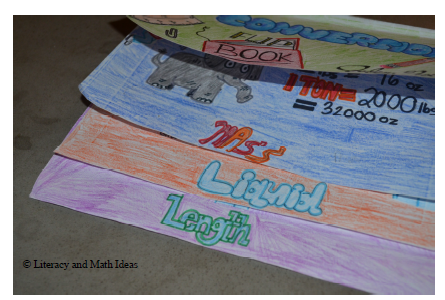
I absolutely love it when students can incorporate their learning styles and talents when they do their work.  I am back to share pictures from a recent activity.  Flip books were created to help students with converting units.  Stop by each week to see some of the fun activities we are doing.

How to Make Them
To create flip books, give each student two sheets of blank paper.  Fold one sheet nearly in half. Fold the second sheet to make one side 3 inches long and the other side 5 1/2 inches long.  Place one paper inside of the other to create the "layers".  Students can write whatever they would like in the flip book.


Math Topic Tuesday: Help Students Master Percents With Math Running Records


There are some things that are used at the lower grade levels that I wish were widely available at the upper grade levels.  One of them is running records.  A running record is an assessment that is used to analyze student reading errors.  This enables a teacher to get the the root of a reading problem to solve it.
Math Running Records for Percents
I developed some running records for use with percents.  I was concerned about my students not only mastering the basics but also being able to solve word problems and problems that could possibly stump them on state assessments.  The even greater goal was to ensure that a solid math foundation is built before they enter high school and take the ACT test.
Students can complete the forms themselves, then students can walk through the results together as an entire class. Doing things this way will help students better know their strengths and weaknesses in math.


I love this because it has helped me target my instruction and individualized student review.


Each math problem gets progressively more challenging.  This enables me to determine if a student has a computation error, can translate word problems into words, or if a student has a shallow understanding of percents but needs more practice with word problems.

Review is very individualized.  Each student focuses on the practice that best fits his or her needs. 

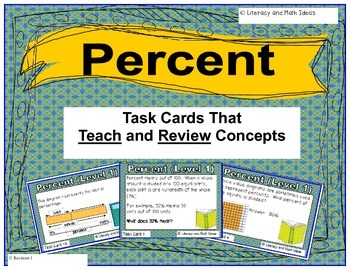
Percent Task Cards (Task Cards That Teach and Review Math


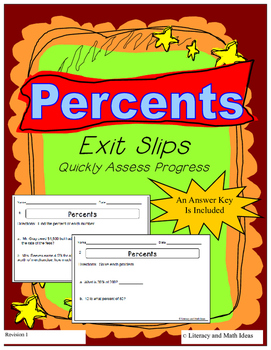
Percents Exit Slips

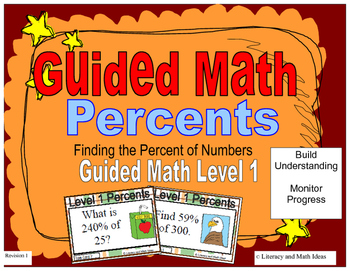
Percents Task Cards (Guided Math Level 1)