Showing posts with label Common Core for Kindergarten. Show all posts

Monday, February 23, 2015

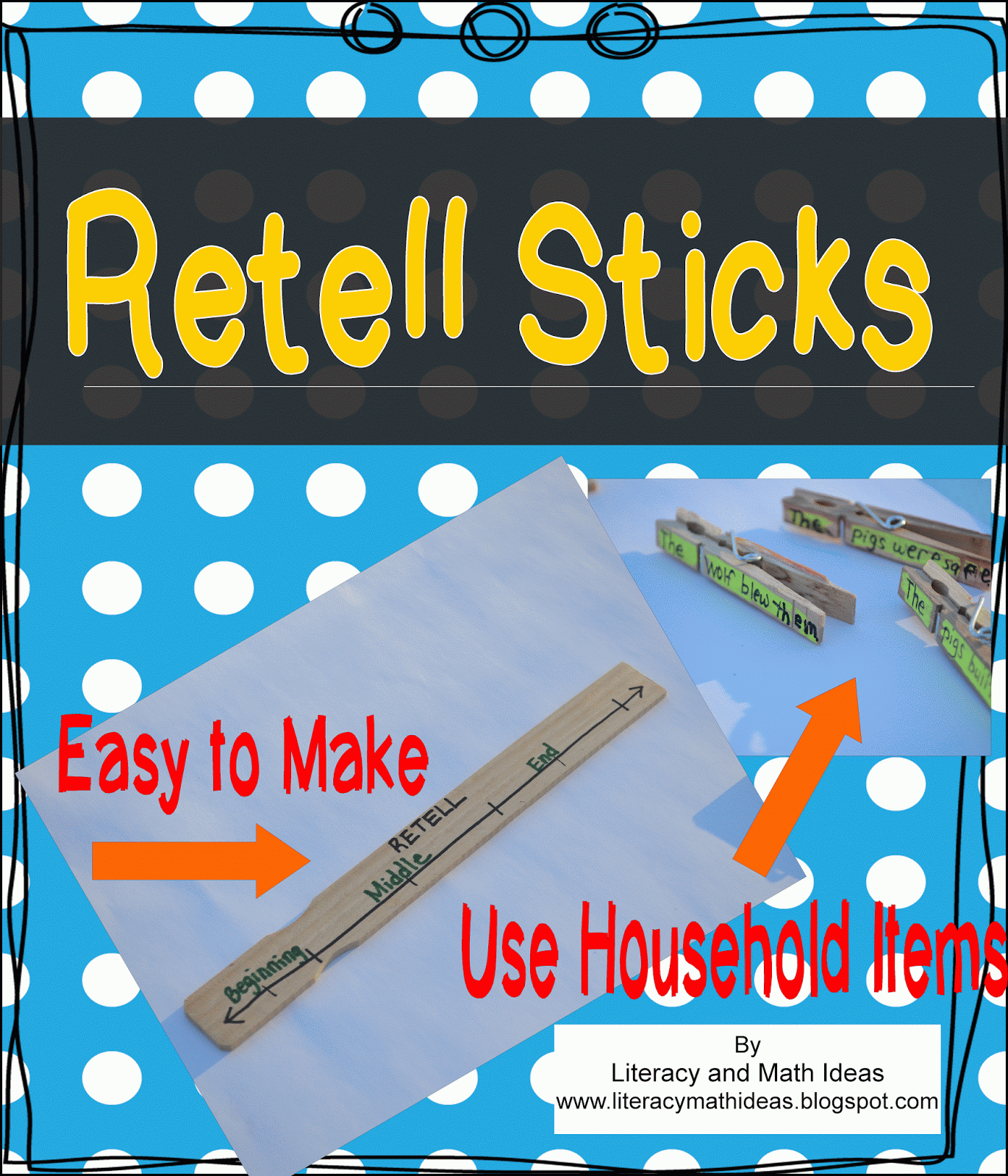
Make Retell Sticks


Making classroom tools from household items is a lot of fun.  This is a literacy center activity that you can make using objects that you most likely already have in your home.


If you have done painting in your home, you just might have a few leftover paint sticks.  If not, your local hardware store might hand you a few sticks free of charge.  

I began by dividing the paint stick into three parts.  They are labeled: beginning, middle, and end.


On some clothespins, I wrote events that occurred in a story that was recently read to the class.  (Put a few wrote details in the mix to test comprehension.)  Students then have to place the clothespins in the correct section on the paint stick.


For Additional Resources For The Classroom, Visit My Store


Monday, December 15, 2014

Differentiated Common Core Literacy Centers


Younger students can range so widely in ability.  If your school district has made the transition to Common Core then you probably have wondered how to meet the needs of beginning readers and those that are still learning basic sight words and still focus on Common Core.

This resource has been so helpful for both my students and myself.  It allows students to work at their own levels and meet the demands of Common Core at the same time. It is such a time saver for teachers too.  Level 1 contains sight words and pictures that students can use as reference points as they locate details.  Level 2 contains longer sentences and words that contain long vowels and short vowel sounds.  Students practice Common Core Standard RL.1 Details and learn how to locate details in the text and closely read.  All of this is done at their own reading levels.

Sunday, June 22, 2014

(Inferences) Close Reading Dry Erase Task Cards That Are Differentiated

This inference version of close reading task cards helps students infer and support their ideas with details from the text.  Students use dry erase markers to identify key text details. They use the blank line(s) on each card to write down their answers.  Click Here To Access It

What makes these cards close reading cards? These task cards are unique because they include a special annotated answer key that shows the important text details that should be identified in the text to answer the question. The answer key also includes the full written answer that should be written. This makes assessing close reading quick and easy.  It also helps students identify important information to help them build inference skills.


Wednesday, June 18, 2014

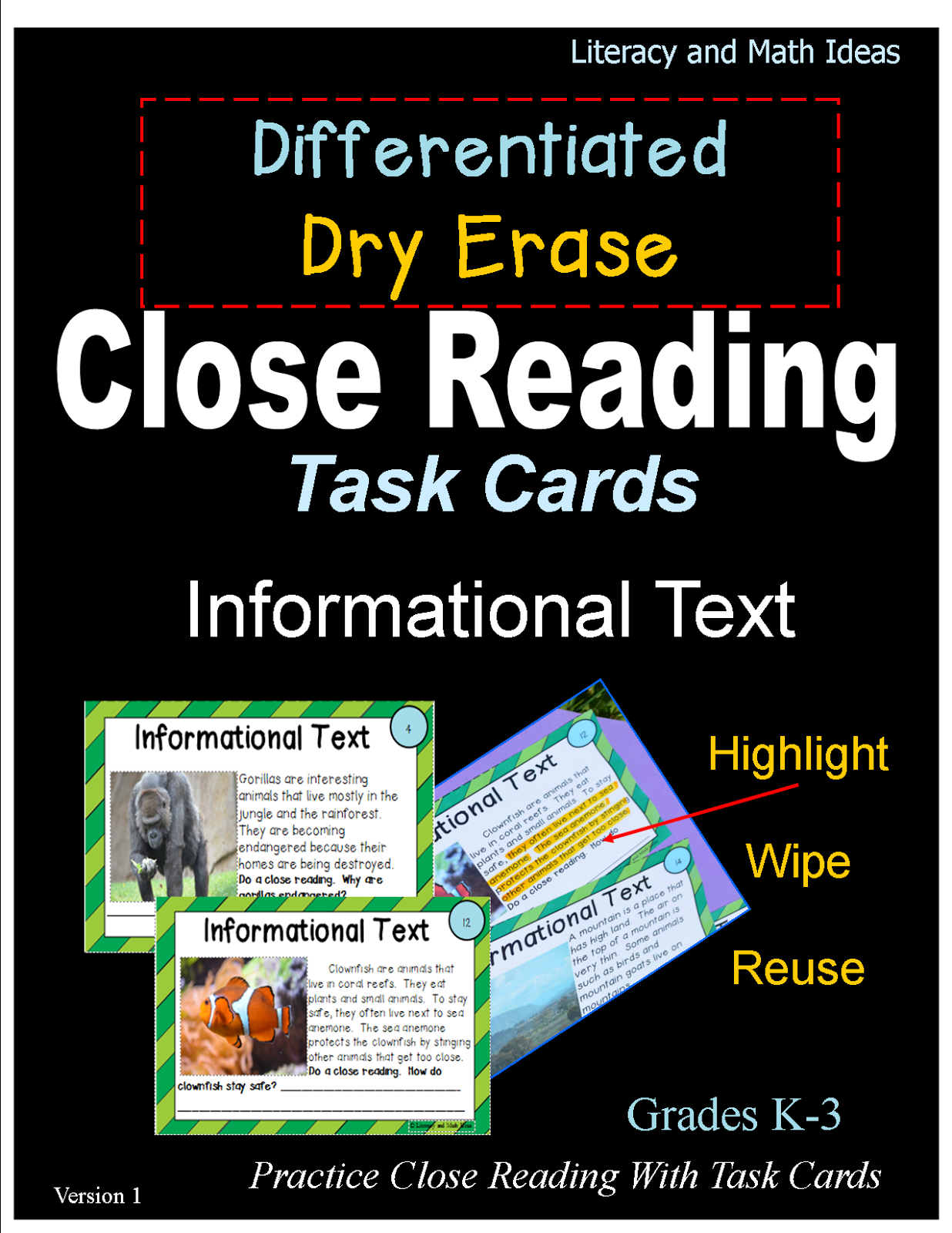
Dry Erase Close Reading Task Cards Informational Text


Close reading practice has made its way to task cards. These task cards enable students to do a close reading directly on the task cards. Students can highlight, underline, or circle the text details that help them determine their answer.  The blank lines on each task card enables students to explain their ideas too. For more information, Click Here


The task cards are differentiated so that students can reinforce close reading skills at their own reading levels.  A detailed answer key shows the text clues that students should have identified in the text.  The task cards can be easily added to a literacy center station to reinforce reading strategies.

The colorful pictures support the informational text passage that is on each card.  Students learn about social studies and science topics as they practice supporting their answers.  A fully annotated answer key has been included that both shows the important details that should be identified in the text and has the written explanation on the blank lines.


Monday, May 26, 2014

Guided Reading Ideas


Managing students while you work with another guided reading group can be tricky. I have always told students that when I am working with a group, no one should talk to me unless it is an actual emergency. 

Placing a tap light on the table beside you is a huge help.  Students will know that when the light is on, no one outside of the small group that you are working with can talk to you.  This is a gentle reminder of guided reading time rules.


Task Cards That Are Organized By Guided Reading Level - Guided Reading Made Easier!


Reading books are organized by guided reading level.  The problem is that it was impossible to find task cards that were organized in this way.  Having one set of lower reading level and one set of higher reading level task cards just did not meet the needs of all the students within my classroom. As a result, I began to make task cards that are organized by guided reading level.  


What makes these task cards unique? These task cards are organized by guided reading level and teach comprehension skills with words that focus on specific phonics sounds. As students progress to higher task card levels, they are introduced to new sounds and review previously introduced phonics sounds. All of this occurs as students practice specific comprehension skills.
These task cards have saved me so much time with lesson planning and have made guided reading instruction so much easier.

Inference Task Cards 


Main Idea Task Cards


Click Here for the Levels J to M Bundle
Click Here for the Levels N to P Bundle


More resources will be released soon.
Follow my TpT store to get updates about freebies and newly released products.


Saturday, May 17, 2014

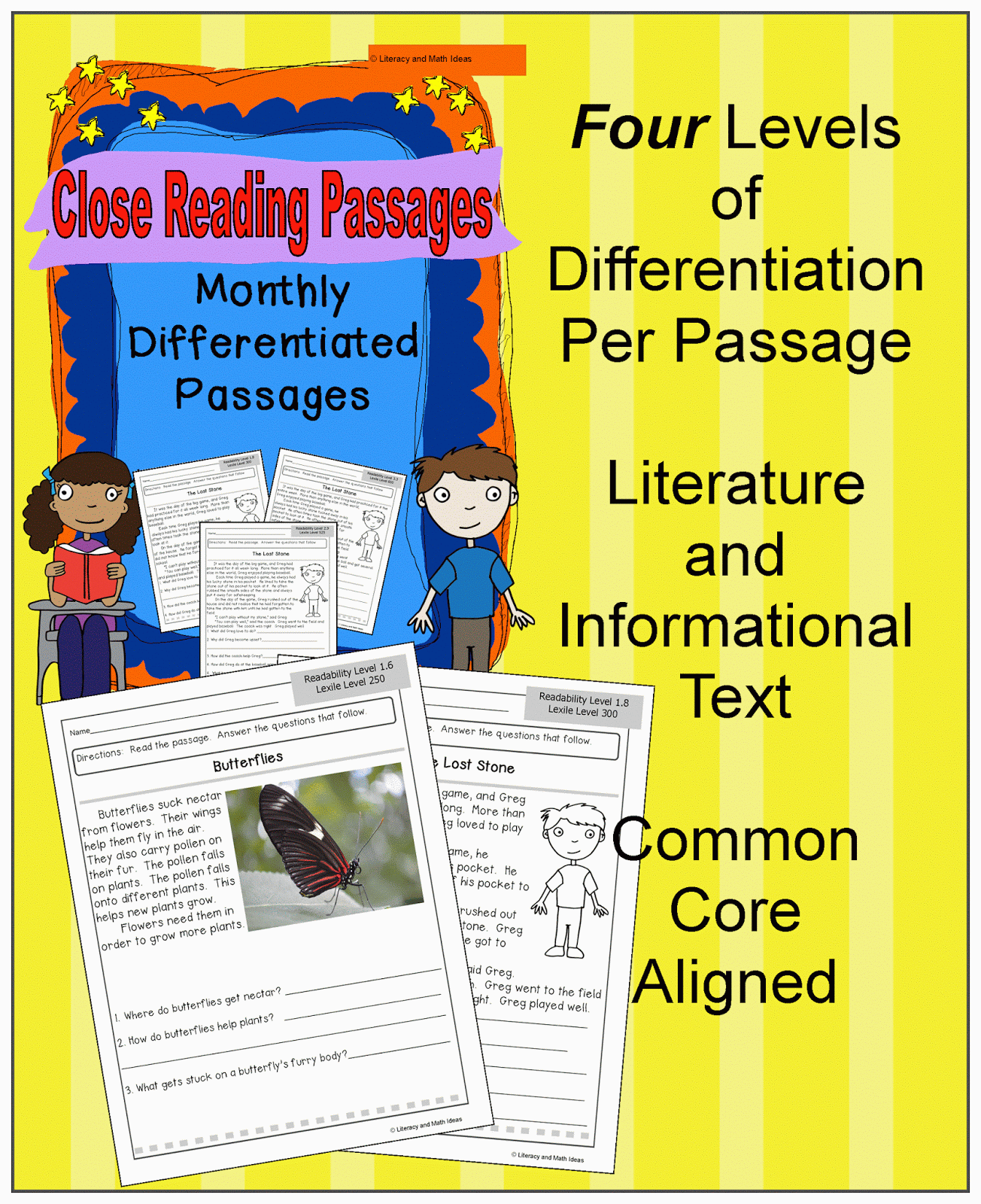
Differentiated Monthly Close Reading Passages


Transitioning to Common Core and meeting the needs of students that read at different levels within your classroom has just become easier.  This document contains 10 different reading passages that are differentiated to meet the needs of students that read at four different reading level ranges (40 passages in all).  Click Here To Access It


Literature and informational text passages are both included.  On day one, students read a passage and answer questions.  On day two, students do a close reading of the passage and write a longer response.  This is a convenient way to integrate Common Core reading and writing skills.  For added convenience, each passage has been differentiated so that if you have students that read at the kindergarten, first, second, and third grade reading level ranges all within your classroom, everyone will have a passage that covers the same topic but is written at their own reading level.  The Lexile number is written on each passage.  Students practice closely reading text, inferring, locating details, character analysis, and more skills but at their own ability levels.  

Students learn about the past, animals, and review realistic fiction with these monthly close reading passages.


Tuesday, April 29, 2014

Toy Truck Phonics


Toy trucks and toy cars are great tools to use to help kids learn how to read.

Materials Needed
a piece of cardboard to use as a ramp
construction paper
a marker
toy cars or toys trucks
scissors


After children learn their letter sounds, they must learn how to blend sounds together to create words.  Some kids grasp this concept easily.  Others take a little longer to do learn this.  

Directions
Cut the construction paper into thick strips. Write a letter on the strip.  Space the letters apart. Tape the strip to a piece of cardboard. Lean it against a wall at an angle.  

To Use
As the truck rolls down the ramp, the child should say the sound that each letter makes. Using the ramp helps ensure that the child says each letter sound in the order that it is written on the strip of paper.  This is a great activity for teaching phonemic awareness and phonics.


Attach different words onto the cardboard.


phonemic awareness games  phonics games  learn how to read reading games

Friday, April 25, 2014

Make a Rhyming Ring Toss Game


Don't you just love Dollar Tree? This blog post discusses how you can create a ring toss game for two dollars (or for free) by using objects from the dollar store.  


Materials
shower curtain rings
an expandable drying rack 
a permanent marker


Write different words on the knobs of the drying rack.  Write words that rhyme with these words onto each individual shower curtain ring.

How to Play
Take turns tossing the ring that rhymes onto its matching knob.

Click Here For More DIY Instructional Ideas


Tuesday, April 15, 2014

Push Up Light Upper and Lower Case Letter Matching Game


Push up lights are a lot of fun.  They are also a handy tool for teaching a variety of concepts. I especially enjoy using them with younger kids.  

To Play
For this activity, place capital letters and lower case letters under each light.  Kids identify matching uppercase letters and lower cases letters by pressing the correct lights.


Monday, February 17, 2014

Using Reading Strategies

In order to comprehend text, readers do several things simultaneously.  Paying attention to text organization, determining what is important, synthesizing information, making connections, asking questions, and making predictions are just a few things.

I typically focus on one aspect at a time during my small group, guided reading lessons with students. Spending time focusing on different aspects of reading is helpful.  


I keep track of how each student performs with reading strategies.


Sunday, September 29, 2013

Use Straws as Teaching Tools and Middle School Close Reading Tips-Literacy and Math Ideas Magazine


K-2 Click Here              3rd - 5th Click Here        Middle School Click Here

This is something brand new- an online free teaching magazine!  New online magazine issues will be posted every two weeks.  Visit Literacy and Math Ideas for free teaching ideas, classroom and homeschool ideas, free resources, and for access to great products.  Click the follow button on the right side of the screen to get updates.

Kindergarten - Second Grade Teaching Ideas

Place Value Straws


Drinking straws are a great tool for teaching multiple skills. Place lines on them to create place value rods to show tens. Cut the segments to represent ones.  Bundle groups of tens to represent hundreds.


Attach two straws to teach counting on to students.  2 + 3 can be represented as three hops from the number two. To create this, get two straws.  Tape both ends together.  Using a permanent marker, write numbers on one straw.  A student can then use a washable marker to write the hops for counting on onto the second straw.


Seasonal Resources:  Fall Literacy Center Games


This collection of three literacy center sorting games reviews short vowel sounds, consonant blends, and long vowel sounds with an autumn theme. Click Here For More Information


Taking Care of You
In the hustle and bustle of being an educator, friend, and life, it is important to take time for yourself.  One way to do this is by taking time with a hobby.

Windowsill Container Garden


With the changing seasons, this may be difficult to do, but starting a windowsill container garden is always an option. Container gardens take up little space.  This is one of my container gardens.  It contains green leaf lettuce.  No matter what the hobby is, the most important idea is taking time to do something that you enjoy.

Have a great week!