Thursday, March 29, 2012

Make Learning Center Bento Boxes!

Yes, bento boxes!  I love Japanese lunch bento boxes, and I also enjoy learning centers.  Hey, why not combine the two!  About 2 years ago, I stocked up on long plastic containers from Dollar Tree.  I have about 25 of them.  

Inside of each one, there are a variety of reading and math center activities.  Differentiate instruction by tailoring each bento box to individual student needs.  Make sure to attach a sheet to the inside of each plastic lid to explain each activity.  Students check out a complete box of activities during their learning center time.

Share your thoughts in the comment section below.

Perimeter, place value, and multiplication facts are reviewed in this bento box.  The flashcards teach and review perimeter.  For more information click the link Click Here: Perimeter Flashcards in my TpT Store

A travel-size Etch-A-Sketch is used for reading response.  The manipulatives are from an old game that I purchased from a resale store.  They are great for solving word problems.  Money is also reviewed in this center.  You can place a Hot Dots pen inside too if you add questions to this box.  The Hot Dots are self-checking.

Sometimes I place books on one topic inside of a box.  Students become experts on one topic before getting a new set of books added to their box.

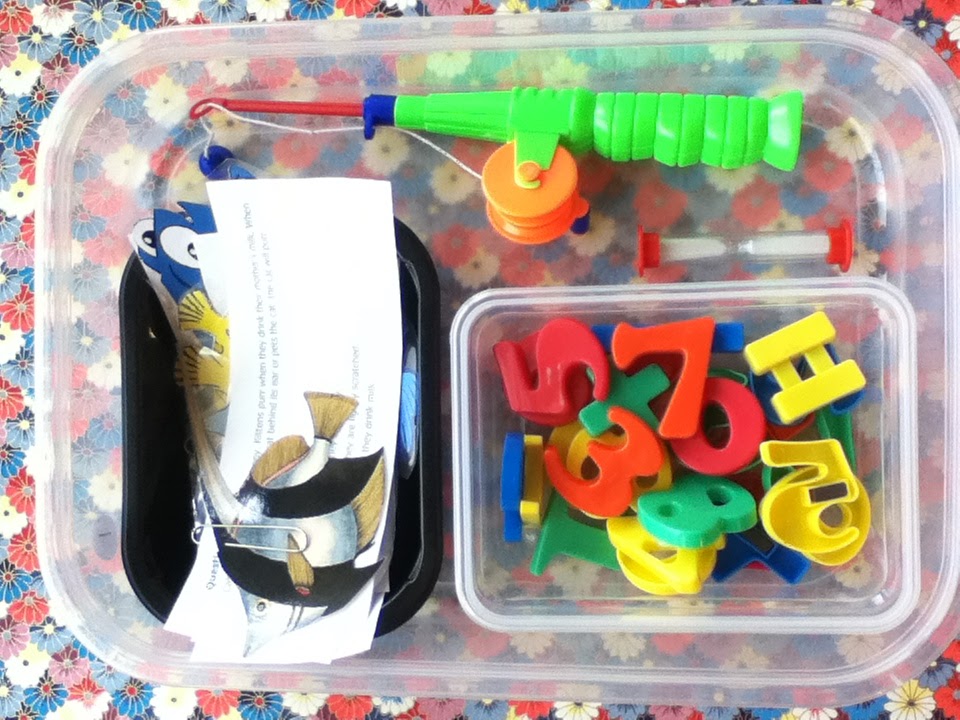
A learning center bento box made for two!  A fishing pole has been added to this center.  Attached to each fish is a comprehension question.  Use paper clips to attach the fish.  Students "fish" for a question to answer.  Students use the numbers to create large numbers for writing or expanded notation.

This is one of my Common Core Task Card sets from my store.  Click the link for the previous  post about Common Core Task Cards.  Click HereStudents answer a task card question, practice fractions with the pizza blocks, and review decimals, percents, or fractions.  

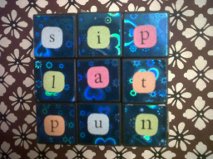
In this box, students draw circles and work on radius and diameter. The literary device task cards review personification, similes, idioms, alliteration, and metaphors.  Students shake the letters to make large words.

Each learning center box is numbered.  Students sign-out a learning center.  The contents of each learning center box can be placed into a jumbo plastic bag if you want to rotate your centers.


A Previous Post You Might Also Like:

Common Core Rubrics for every ELA Literature and Informational Text Standard!  These handy rubrics are excellent for guided reading, student portfolios, and conferring with students.
Click Here For Kindergarten
Click Here For Grade 1
Click Here For Grade 2
Click Here For Grade 3
Click Here For Grade 4
Click Here For Grade 5
Click Here For Grade 6
Click Here For Grade 7
Click Here For Grade 8


For the entire previous post, click here

Wednesday, March 28, 2012

Math Common Core Standards Task Cards for Grades 1 and 2


Spring break has been fun!  Even if you love your job, a break sometimes is still good.  I am back with Common Core Math task cards this time.  Yippee!  They cover ALL (Yes All) The categories in the math standards.  Click the links for more information.


Saturday, March 24, 2012

How to Transform Dollar Store Finds Into Classroom Treasures


Okay, we have all done it.  We have all gone to our local dollar or discount store and bought that item that we just could not pass up.  Who could blame us? I mean, it was only a dollar.  Today, we will look at Dollar Store finds and transform them into classroom treasures.  And yes, each item only cost me one dollar.  This post is just part one.  I will be back soon with more.

This innocent looking cutting board can make an excellent reading response paddle.

During guided reading, students can interject their ideas by holding up their paddles.


The "Magic Cube", you know the Dollar Store cousin of the Rubik's Cube, can make a great learning center for making words.  

Students turn each row and try to make a word in any direction.  The Dollar Store even sells letters too.  If you can't find them, your local craft store should have them.  For older kids, paste prefixes, suffixes, or roots onto each square.
Use the Dollar Store binders and plastic protectors to create centers.

Wednesday, March 21, 2012

State Testing is Over Yippee!

I had to take a small break from so much fun to do some state testing review :(  .  Sometimes you have to do what you have to do.  There are some fun things that I want to show and share this week so check back!

Thursday, March 15, 2012

Sale! Common Core Task Cards

I'm having a St. Patrick's Day sale on all of my Common Core task cards for two days only.  There are now fifth grade Common Core task cards too!


These are great to use in learning centers, for guided reading, and book discussions.  Each grade level covers ALL of the major categories in the Common Core Standards for both the literature (fiction) and informational (nonfiction) sections.  Use them with any book or magazine.  


The link to my original document Common Core Standards Task Cards is also included.  The original is worded in a way that it can be used at any grade level kindergarten through fifth and can be used to differentiate instruction if you have students at different ability levels.  Click on the link below.
Kindergarten
Grade 1
Grade 2
Grade 3
Grade 4
Grade 5


Wednesday, March 7, 2012

Free Common Core Standards Bookmarks

Greetings all!  Free Common Core Standards bookmarks are included with this post.  I developed these as reminders for my own students about what to focus on while reading.  These are great resources for the Common Core Standards.  Although I say they are for the Common Core Standards, these bookmarks are actually best practices for reading.  As a result, they can be used even if your school or region does not have Common Core Standards.  

As a K-8 instructional coach, I have to do a huge amount of research. This includes visiting top performing elementary and high schools, talking to college professors, and the list goes on and on.  The things listed on the bookmarks are a summary of some of the major things a student will need to be able to do to analyze what they have read.  

Previous Posts You Might Like:

Common Core Exit Slips
These exit slips can be used with fifth grade students and high or advanced fourth graders too!


These exit slips are aligned to the Common Core Standards and are a quick and convenient method of assessing student understanding.  The Inference Exit Slips contain short stories that address many of the themes that are common to middle school literature such as acceptance, utopian societies, dystopian societies and more.  The Figurative Language and Literary Device Exit Slips are designed to help students identify and analyze figurative language and literary devices within text.

Monday, March 5, 2012

An Award!


Heather at www.begborrowteach.blogspot.com has brightened my day!  I was just awarded the Lovely Blog Award.  There are so many fantastic blogs out there.  At this time,  I would like to celebrate the wonderful things that so many bloggers out there are doing.  

I have blog sites that I want you guys to visit.  Please check out the sites below:

Heather at http://begborrowandteach.blogspot.com/
Fern at http://fern-smith.blogspot.com/

Sunday, March 4, 2012

Freebie From: Long Vowel Sound Reader's Theater, Literacy Centers, and 23 Worksheets


To celebrate 10,000 page views in 2  1/2 months I have uploaded this rhyming game onto Google Docs as a freebie.  It is from my document Long Vowel Reader's Theater, Literacy Centers, and 23 Worksheets in my TpT store.  The complete document has 5 reader's theater scripts to review long vowel sounds, 6 literacy center games, and 23 worksheets.  


This is one of the games from the document.  It was uploaded onto Google docs for easy access.  Click the link below.

Click Here

If you would information about the complete document, click here:
Click Here

Friday, March 2, 2012

Making Connections: Teaching Students to Go Deeper in Reading

Today's post will focus on strategies for helping students make deeper level connections to text.  On a side note, earlier this week, we began celebrating 10,000 page views.  You guys are fantastic! The celebration is not over.  I am going to upload some really valuable freebies throughout the next week.  Make sure to check back throughout the next 7 days.  


Making Deeper Connections
If I hear another student say while we are reading, "This reminds me of the time I went to the zoo, bank, (or anything close to this),"  I promise you I will scream very loud and I won't stop for 2 minutes.  I have felt so strongly about this that I have made adjustments to how I help students make connections.


Stephanie's Harvey's main intent with encouraging students to make connections in her book Strategies that Work was to have students connect to central ideas in the text.  This is much needed for success in high school as well as college.  Learning this is often very challenging for students because reading is so different than math.  Math topics are organized by common themes.  Reading should be organized the same way to the smallest level.  I even recommend creating a list of connections you want students to be able to make.  Plus organize lessons by theme or key idea as well as by reading skill and reading strategy.  


A list of recommended books are listed below.   Even if you teach older students, these books are short and are great for guided lessons with students.  Possible thematic connections include:


Accepting Oneself 
Books to Use:
A Bad Case of Stripes by David Shannon
Ira Sleeps Over by Bernard Waber
Ruby the Copycat by Margaret Rathmann
You Are Special by Max Lucado (Highly Recommended)


How and Why Characters Change Over Time 
Books to Use:
Somebody Loves You Mr. Hatch by Eileen Spinelli (I Love This Book Too!)
An Angel for Solomon Singer by Cynthia Rylant


Overcoming Obstacles 
Books to Use:
Leah's Pony by Elizabeth Friedrich (Trust Me!)
There a zillion books that fit this category


Informational Text Topics to Read About Include:
Animal Adaptations (Body Features and Things Animals do to Survive)
The Great Depression
Early Beginning of Our Country
Animal Habitats
Ancient Civilizations (Rome, Egypt, Mesopotamia, etc.)


Possible Discussion Prompts Include:
What lesson did the character learn?  Can you think of another story in which a character learned the same lesson?


What does the author want the reader to learn?  Can you think of another book in which another author wanted us to learn the same thing?  How are both of these authors the same or different in the way they get the reader to learn this?


Can you think of a time in which you learned the same lesson?  Explain.


Now that we have read about several civilizations, what do you notice that is the same about all of them?