Usually, I post pics of what I am doing with students across the grade levels. I will also post links to free downloads. Click on the link Long Vowel Practice Sampler for a free download of long vowels activities.
Check back over the next few days because boy oh boy do I have some fun ideas and pics to share!
Long-Vowel-Practice-Sampler
Friday, December 30, 2011

Tuesday, December 27, 2011
Kandinsky Inspired Reading & Math

I love art! I love Wassily Kandinsky. I love Andy Warhol. I love Pablo Picasso. I love Diego Rivera. I love reading. I love sleeping. I love doing absolutely nothing. (Okay, okay,you get the hint).
I definitely love integrating art with reading and math. Integration is the heart of the the upcoming Common Core Standards. Today, I will share several ideas that can be used to integrate reading and math with art.
How to Do It:
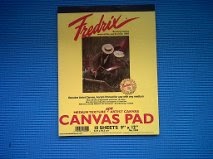
Begin by cutting a canvas pad into four rectangles that are equal in size.
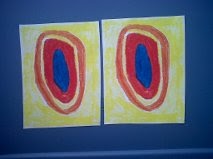
The students can read or listen to a biography about Wassily Kandisky as well as look at his artwork. He is famous for his Squares With Concentric Circles abstract art. Hand each student a square to make their own version of his art.
Color copy the squares, laminate them, and use them as manipulatives!
 |
| Addition 1 + 1 = 2 |
 |
| Patterns abcabca Teach Arrays |
 |
| 1 x 2 array |
 |
| 2 x 2 array |
- Have students read about the lives of artists to learn about the features of biographies.
- Learn about the different genres.
- Compare and contrast the lives of two famous artists.
Thursday, December 22, 2011
Using Flowcharts to Increase Comprehension
Okay, you have just taught an award winning lesson. It was hands-on, engaging, included the Common Core Standards, and was differentiated. In fact, you want to pat yourself on the back for a job well done. But wait a moment. All the students seem to understand except for Carla and Nate. Flowcharts are a great way to help students remember step-by-step what to do. If a student has difficulty remembering steps for math, what to pay attention to when they are analyzing characters, or even reading strategies, I usually work with the student one-on-one and introduce flowcharts.


Wednesday, December 21, 2011


Tuesday, December 20, 2011
Pop-Up Books Part 2
Since each book requires so many pics to show adequately, I will post books over the next few days.


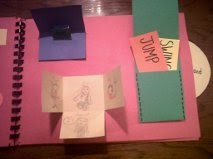


This is a book about verbs. This is a great multisensory way to teach and review concepts. Teacher created books can be used as a literacy or math station.
 |
| The graphic folds back into the book when the page is turned. |
 |
| The airplane moves and the picture pops out when the paper is unfolded. |
Monday, December 19, 2011
Pop-Up Books Part 1 (The Basics)
Put aside everything you have ever thought of about children when it comes to children making their own books. When you introduce pop-ups, foldable tabs, and flips to student made books, book making goes to another level. I work with students from kindergaren thru eight grade level with both reading and math as an instructional coach. Kids and parents love these books. I also do teacher workshops. Of all the workshops, this one is a surefire favorite.
Not only are these books cute, but they are a sneaky way to get students to review concepts they have learned. Shhh! Do not tell that part to the students.
Throughout the week, I will show the basics about pop-ups and book making and then show you examples of books that kids have made and that I have made as demos for teachers.
Teachers use these in a variety of ways. Some use these books as visual notes to review a topic or theme. Others place the books in learning centers as review activities. Still some have students create their own books as book reports.
Materials Needed:
- file folders or card stock (this will be used as your book)
- glue or tape
- scissors
- a variety of pieces of card stock
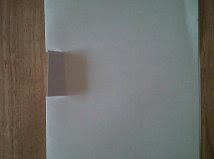 |
| Step 1: Fold your paper in half. In the middle, cut two lines about an inch apart. |
 |
| Step 2: Bend this tab to make it flexible. |
 |
| Step 3: Open the paper, and pull the tab that you have made inside out. |
 |
| Step 4: This is what it should look like when the paper is refolded. |
 |
| Step 5: Open the paper. It should look like this and have a pop-up tab. |
 |
| Step 6: Students can add whatever they would like to the pop-up tab. I placed it off center for you to see it easily. |
Wednesday, December 14, 2011
Pop-Up Books Kids Can Make (Coming Soon)
Okay, I admit the fact that I try to find sneaky ways to get kids to learn. I have fun. They have fun. It's a win win situation. What I have found is that when they create their own books to learn reading and math concepts, kids really internalize the ideas.
Visit back and I will share some of the pop-up books that I make with students.
Visit back and I will share some of the pop-up books that I make with students.
Tuesday, December 13, 2011
3D Literacy Center
We all know that 3D is all the rage these days. How about bringing the 3D craze to learning centers. This center is sure to motivate the most reluctant reader to read. I stock my center with 3D glasses and 3D books. I have even found some 3D books at Dollar Tree!


Monday, December 12, 2011
Critical Thinking on a Budget
Teaching can be very expensive. Between trying to save the planet, shaping young lives, and writing lesson plans, it can be challenging not to buy just one more thing for the classroom (Okay english majors, I know this is poor parallelism). That's why I love resale shops. For whatever reason, people love to donate their thinking games to thrift stores. I'm not complaining, remember I'm on a budget. I love adding thinking games to my learning center rotation. Some of my favorites include:
 |
| Is it possible to be in love with a game? This is a great game for teaching deductive thinking skills and strategic thinking. |
 |
| Rush Hour. Isn't the name exciting? You can just imagine all of the critical thinking skills that can come out of sitting in rush hour traffic. Really speaking though, this is a great deductive reasoning game.  but have I ever steered you wrong before? This game is great for teaching visual and strategic thinking. |
Saturday, December 10, 2011
Water Bottle Learning Centers Part II
As we approach the holidays, students become restless. New literacy and math centers are a great way to get students to refocus.
Okay, so far we have saved the planet by reusing water bottles. Yippee! Are you ready to have more fun? I have included mostly literacy center activities on part two. I often place my centers into Ziploc bags and replace them often to keep my centers stations fresh.
Okay, so far we have saved the planet by reusing water bottles. Yippee! Are you ready to have more fun? I have included mostly literacy center activities on part two. I often place my centers into Ziploc bags and replace them often to keep my centers stations fresh.
 |
| The spelling task cards are actually from Mrs. Stamps classroom website. Include Scrabble letters and a plastic bottle and voilà, you have an instant center that is easy to store.  |
 |
Pattern Center |
 |
| Clip them onto each genre bottle to sort them. |
 |
| Word Sort Laminated words from newspapers make a great center.    |
Friday, December 9, 2011
Water Bottle Learning Centers

Water bottles make great learning center stations. They are easy to store and are convenient for carrying. Take a look at some of mine and how water bottles can be used in the classroom.
After sanitizing, allow the bottles to dry for about a day.

By adding pieces onto the end of popsicle sticks so that students can touch the perimeter or area of a shape.

Place multiplication, addition, division, square roots, or vocabulary words onto the back of sticks. Students flip over the sticks to check their answers.


Additional Resources:
 |
| Teach Author's Purpose With Pretend Potato Chips |
 |
| Common Core Aligned Differentiated Resources For Guided Reading |
Subscribe to:
Posts (Atom)